WIKI: "Produced in 1989, the film is presented in black and white combining authentic archival newsreel footage of Harlem in the 1920s with scripted scenes to produce a non-linear impressionistic story line celebrating black gay identity and desire during the artistic and cultural period known as the Harlem Renaissance in New York."
ABOUT: "Small digital camera in hand, Cavalier dives into the memories he set down in his diaries from the early 1970s, in search of the essence of Irène, the love of his life, who was killed in a car crash…
"She's at the door," Alain Cavalier confesses. "For years, I’ve heard her, knocking gently. Why has it taken me so long to open the door to her? Am I afraid of the claims she might make? Afraid of some kind of confession? Am I unwilling to shine a light into the dark corners? One thing I know: she stands there, alive, stands before me, steers my hand. I am trying to go beyond where we left off – only yesterday.."
WIKI: "Vampyr is a 1932 horror film directed by Danish director Carl Theodor Dreyer. The film was written by Dreyer and Christen Jul based on elements from J. Sheridan Le Fanu's In a Glass Darkly. Vampyr was funded by Nicolas de Gunzburg who starred in the film under the name of Julian West among a mostly non-professional cast. Gunzberg plays the role of Allan Grey, a student of the occult who enters a small village outside of Paris which is cursed by supernatural creatures known as Vampyrs who lure townspeople to suicide so they can become servants for the devil."
ABOUT: "Canadian filmmaker and actor Johnny Terris started out doing short films in the late 80’s and early 90’s in Canada. Starting at the age of 14 and leaving home at 16 years of age his films viciously delved into trailer park comedy that centered on a comedic annihilation of family values and structure. In 2005, he released Sordid; a grotesque experimental horror journey through death and rebirth which sold out the first 200 copies within a 24 hour period."
Imdb: "Ernie Gehr's structuralist masterpiece SERENE VELOCITY is a hypnotic film which is nothing more than a rapidly edited, rhythmic piece consisting of two shots of an office hallway (one long shot, one zoomed-in close up)."
ABOUT: "Bruce Baillie's innovative films grab the viewer with eloquent and rich imagery as well as a heartfelt humanism and concern for his subjects expressed through a lyrical sensibility.
The natural and intimate pictorial handling of Mr. Hayashi is characteristic of all of Baillie's work, especially the deeply moving Mass for the Dakota Sioux (1963-1964)."
The Guardian's review:
""Turner," said Steve McQueen at yesterday's opening of the Venice Biennale, "does not own sunsets, and he doesn't own Venetian sunsets." And so it is that the London-born artist, who this year represents the UK at the world's most important and unashamedly flamboyant art event, has dared to make a romantic, lyrical, melancholic film that shows Venice hazed through mists and sunsets, dripped in wintry rain.
It ought to be a cliche, but it is not, for the Venice of McQueen's minutely observed 40-minute film is not the Venice of St Mark's Square or humpbacked bridges over picturesque canals. His Venice is the Venice of the Giardini, the city's municipal gardens. In this park stand the pavilions, each devoted to a different nation, that are filled with art every other year during the Biennale – where, in the summer, art world types air-kiss and gossip. But McQueen's film was shot in the dim light of February, after the art from the last Biennale had long gone, the pavilions were boarded up and piles of rubbish lay scattered over the lawns and paths.
The plangent film, called Giardini, is already causing a stir at Venice as one of the most talked about of the 77 national offerings for the festival, which opens to the public on Sunday."
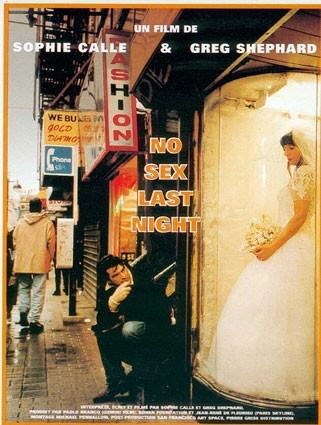
WIKI: "In 1996, Calle released a film titled No Sex Last Night which she created in collaboration with American photographer Gregory Shephard. The film documents their road trip across America, which ends in a wedding chapel in Las Vegas. Rather than following the genre conventions of a road trip or a romance, the film is designed to document the result of a man and woman who barely knew each other, embarking on an intimate journey together."



 Posts
Posts

